

Reverse osmosis, commonly called RO, is a water treatment process in which water is forced through a semi-permeable membrane that removes impurities, contaminants, and dissolved solids. RO systems are highly effective at producing cleaner, great-tasting water by reducing substances such as chlorine, lead, nitrates, fluoride, and total dissolved solids (TDS).
Special Notice: Replacement cartridges purchased online (Amazon or other retailers) are not approved or certified for use with Kinetico products, may not perform to specifications, and their use will void your product warranty.
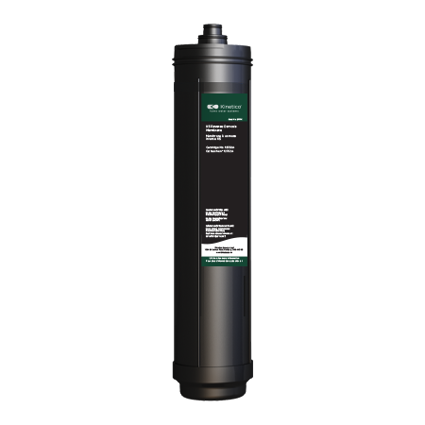
The reverse osmosis process uses a semi-permeable membrane to separate water from contaminants. “Semi-permeable” means that some things can pass through and others can’t. A familiar example would be your furnace’s air filter. A key difference in semi-permeable membranes for water treatment is that they allow passage based on the size of the particle and its molecular charge. Typical air filters separate the contaminants exclusively by size. Holes, or pores, in the RO membrane are just big enough for the passage of a water molecule. Even small particles such as tobacco smoke or paint pigments are too big to flow through an RO membrane. At this point, because the membrane only lets certain molecules pass through, there is some waste. The waste, a highly concentrated solution of contaminants, is sent to the drain. You are left with virtually contaminant-free, clean water that makes it through the membrane.
If your water comes from a municipal water system, the water is treated at the plant, which could be miles and miles from your home. After the water is treated, it is transported to your home through a water distribution system. The distribution system consists of many pipes that are often underground and, in many cases, quite old. Aging pipes, a small crack, or other scenarios can be responsible for contaminants entering the water supply before it reaches your home
Reverse osmosis filtration is often referred to as one of the most effective ways to reduce contaminants in your water, such as mercury, PFAS, total dissolved solids (TDS), and more. The FlexFilters offered with the K5 Drinking Water Station help to provide a wider, case-specific blanket of protection for your home's drinking water.
Filters like our Chloramine Guard are made specifically to target and reduce levels of chloramine that can be found in municipal water. Over 1/3 of the municipal water in the US is filtered using chloramine, meaning trace amounts are found more often than not. While it's not deadly, it can cause issues over time, especially if your water contains a significant amount.
The K5 Drinking Water Station can have our Mineral Plus filter added in tandem with our post filter. Reverse Osmosis filtration is sometimes considered "too strong", in that the process even reduces levels of "healthy" minerals that can naturally be found in our water. This filter is designed to add minerals such as magnesium and calcium back into the purified water, while keeping the same cleaner, more refreshing taste and high-quality.